Pockets: A Gendered History
For centuries, men had pockets and women did not—a gap that changed how they carried their lives.
Before you read
5 key words from this story
Highlight a sentence, leave a note
Select any sentence in the story to share what you think. Your notes appear right on the text, so your classmates can read them, react, and reply — exactly where it matters.
What it looks like
The river carved its path through the valley as the town looked on.
3 notes · click any highlight to read them
A Hidden Inequality
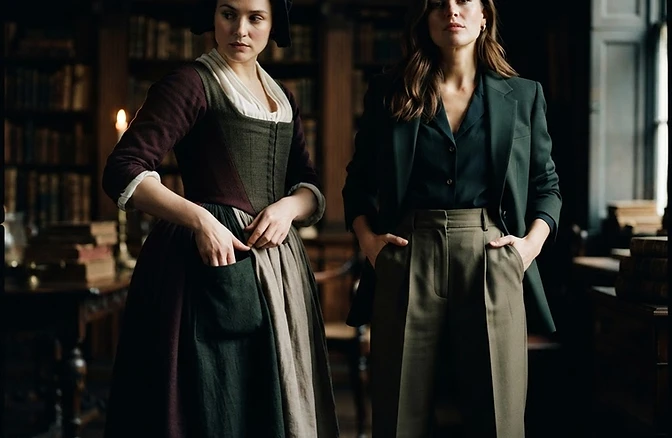
If you look at the clothing of men and women, you will notice a strange difference: pockets. Historically, men’s trousers and coats were filled with deep, functional pockets. Women’s clothing, however, often lacked them, relying instead on small handbags. This was not just about fashion; it was a way to control how much space women occupied in the world.
The Tie-On Pocket
In the 17th and 18th centuries, women actually wore "pockets," but they were separate items. These were bags that tied around the waist under their skirts. Through a slit in the fabric, women could reach in and grab their keys, money, or sewing kits. They were hidden, secret, and incredibly useful.
The Tie-On Pocket In the 17th and 18th centuries, women actually wore "pockets," but they were separate items.
The Shift in Style
When fashion changed in the late 18th century, skirts became much slimmer. The bulky tie-on pockets ruined the new, elegant silhouette. Instead of building pockets into the dresses, fashion designers created the "reticule"—a small, delicate bag that had to be carried in the hand. Suddenly, women had to carry their belongings in a way that was visible and less secure.
The Message in the Fabric
This change carried a social message. A man’s pocket was a tool for work, travel, and independence. A woman’s handbag was an accessory that kept her hands busy. For a long time, not having pockets meant that women were dependent on someone else to carry their things or were limited in what they could take with them when they left the house.
The Modern Movement
Today, the fight for pockets is a real movement. Many women are tired of fake pockets or tiny, useless ones that cannot even hold a smartphone. Clothing brands are slowly listening, adding functional pockets to trousers and dresses. It is a small change, but it is one that gives women more freedom and utility in their everyday clothes.
You're done
You just spent 3 minutes reading in English.
Enjoyed this story?
Tap the heart to let other readers know you enjoyed it.
My notes
Jot down personal reflections while you read — saved so you can review them later.
Check your understanding
4 questions with instant feedback
Let's talk about it
4 questions to spark conversation
Join the conversation
Your English doesn't have to be perfect — your ideas are what matter.
Respond to a question
Or share your reaction
No thoughts yet — be the first to start the discussion.
More from today


The Library of Babel: A Digital Infinite
An online project recreates a fictional library containing every possible combination of letters, effectively holding all knowledge and nonsense.
Cheese: A Happy Accident in a Bag
Long ago, a traveler discovered that milk stored in an animal stomach turned into something delicious and solid.
🕳️ Want to go deeper?
Keep exploring
Are there other common items that were once gendered?
How do pockets influence the design of modern technology like smartphones?
Take It With You
A few useful things you picked up
From “Pockets: A Gendered History”.
Useful Expressions
Functional
B2 · adjective
Designed to be useful rather than just beautiful.
“These boots are very functional for hiking.”
Useful for describing objects with a purpose.
Silhouette
C1 · noun
The shape or outline of something.
“She saw the silhouette of the mountain against the sky.”
Commonly used in fashion and art contexts.
Accessory
B2 · noun
An extra item added to something, like a bag or jewelry.
“She bought a new scarf as an accessory for her coat.”
Essential for discussing fashion.
Utility
C1 · noun
The quality of being useful.
“This app has great utility for students.”
A sophisticated way to talk about usefulness.
Your English
You don’t need to memorise these now. You’ll meet useful language again as you keep reading.
See you tomorrow.
View your collection