The Frog Battery: A Shocking Experiment
In the 18th century, scientists discovered that electricity could make dead frog legs move, changing our understanding of life and energy.
Before you read
4 key words from this story
A Strange Discovery
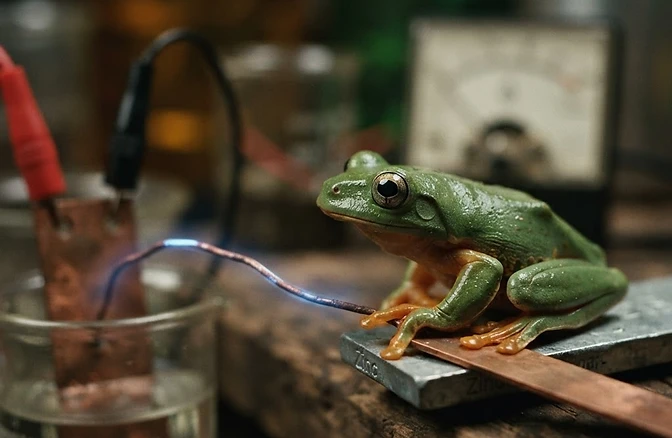
In the late 1700s, an Italian scientist named Luigi Galvani noticed something very strange in his laboratory. He was working with frog legs when a spark of electricity touched them. Suddenly, the dead legs began to twitch and move as if they were alive. This moment was not just a weird accident; it was the beginning of our modern understanding of bioelectricity.
The Spark of Life
Galvani believed that animals contained a special kind of 'animal electricity' that lived in their muscles and nerves. He thought this energy was the secret to life itself. While he was not entirely correct about the source, his experiments proved that electricity plays a vital role in how our bodies function. Every time you move your arm or think a thought, your body is using tiny electrical signals.
While he was not entirely correct about the source, his experiments proved that electricity plays a vital role in how our bodies function.
From Frogs to Batteries
This discovery led to a famous debate with another scientist, Alessandro Volta. Volta did not agree with Galvani. He believed the electricity came from the metal tools used in the experiment, not the frog itself. This argument pushed Volta to create the first real battery, known as the 'Voltaic Pile.' Without this competition between two men and a frog, our modern world of gadgets might look very different.
The Legacy of the Experiment
Today, we know that electricity is the language of the nervous system. Doctors use this knowledge to help people with heart problems using pacemakers, which send small electrical pulses to keep the heart beating correctly. The frog experiment was the first step toward these life-saving technologies.
Science in the Past
Looking back at these early experiments reminds us that science is often messy and strange. It is rarely a straight line from a question to an answer. Sometimes, it takes a dead frog and a big argument between two scientists to change the world forever. It shows that curiosity, even when it leads to weird places, is the most important tool for progress.
You're done
You just spent 3 minutes reading in English.
Enjoyed this story?
Tap the heart to let other readers know you enjoyed it.
My notes
Jot down personal reflections while you read — saved so you can review them later.
Check your understanding
4 questions with instant feedback
Let's talk about it
4 questions to spark conversation
Join the conversation
Your English doesn't have to be perfect — your ideas are what matter.
Respond to a question
Or share your reaction
No thoughts yet — be the first to start the discussion.
More from today


The Mirror: A Tool That Changed How We See Ourselves
Before glass mirrors were common, people rarely saw their own faces, which shaped how they understood their identity.


The Secret Language of Trees: How Forests Talk
Trees are not just standing still; they are part of a complex underground network that shares food and warnings.
🕳️ Want to go deeper?
Keep exploring
How do pacemakers actually work inside the body?
What other 'accidental' scientific discoveries changed the world?
Take It With You
A few useful things you picked up
From “The Frog Battery: A Shocking Experiment”.
Useful Expressions
twitch
B2 · verb
To make a small, sudden movement.
“His eye started to twitch when he was tired.”
Useful for describing physical reactions.
spark
B2 · noun
A tiny flash of light and heat caused by electricity.
“A spark jumped from the wire to the metal.”
Common in scientific and metaphorical contexts.
vital
B2 · adjective
Extremely important or necessary for life.
“Water is vital for all living things.”
A strong, useful word for importance.
gadget
B1 · noun
A small, useful machine or tool.
“He loves buying every new kitchen gadget.”
Essential for talking about modern technology.
Your English
You don’t need to memorise these now. You’ll meet useful language again as you keep reading.
See you tomorrow.
View your collection