The Humble Stapler: A Royal Tool for Paperwork
Before the modern stapler became a desk essential, it was a custom-made luxury item used by French royalty to secure important documents.
Before you read
4 key words from this story
A Royal Beginning
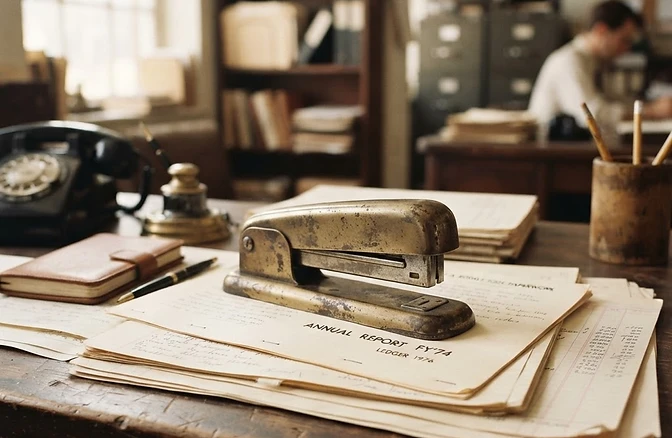
We often think of the stapler as a boring piece of office equipment, something we grab without a second thought when we need to organize a few pages. However, the history of this device is surprisingly regal. The first known stapling device was created in the 18th century for King Louis XV of France. Each staple was handmade from gold and engraved with the royal insignia.
From Luxury to Necessity
For a long time, stapling was a privilege reserved for the elite. Because the staples were made of precious metals and the machines were crafted by hand, they were far too expensive for the average person. It wasn't until the Industrial Revolution that inventors began to look for ways to mass-produce a more practical version for the growing number of businesses and offices.
Because the staples were made of precious metals and the machines were crafted by hand, they were far too expensive for the average person.
The Mechanical Shift
In the late 19th century, several patents were filed for machines that could use wire to bind paper. These early versions were often clunky and difficult to reload. It took decades of trial and error to develop the spring-loaded mechanism that we recognize today. The transition from a luxury status symbol to a common tool mirrors the broader democratization of technology during the 20th century.
Why We Still Use Them
Despite the rise of digital documents and cloud storage, the physical stapler remains a staple of the modern workspace. There is a tactile satisfaction in physically binding documents that digital files simply cannot replicate. It provides a sense of permanence and organization that helps us manage our physical environment in an increasingly virtual world.
A Lasting Legacy
Today, the stapler is a global icon of efficiency. While we no longer use gold staples to impress monarchs, the basic principle remains the same: a simple, effective way to keep our ideas together. It serves as a reminder that even the most mundane objects often have stories of innovation and evolution hidden beneath their plastic exteriors.
You're done
You just spent 3 minutes reading in English.
Enjoyed this story?
Tap the heart to let other readers know you enjoyed it.
My notes
Jot down personal reflections while you read — saved so you can review them later.
Check your understanding
4 questions with instant feedback
Let's talk about it
4 questions to spark conversation
Join the conversation
Your English doesn't have to be perfect — your ideas are what matter.
Respond to a question
Or share your reaction
No thoughts yet — be the first to start the discussion.
More from today


The Hayfever Hat: A Lesson in Bizarre Design
An exploration of 'Chindogu', the Japanese art of creating 'un-useless' inventions that solve problems in the most inconvenient ways possible.
The Inuit Goggles: A Survival Innovation
Long before modern sunglasses, the Inuit people developed ingenious bone goggles to protect their eyes from the harsh glare of the Arctic sun.
🕳️ Want to go deeper?
Keep exploring
How did the invention of the paperclip change office culture?
What other luxury items from the 18th century are now common household goods?
Take It With You
A few useful things you picked up
From “The Humble Stapler: A Royal Tool for Paperwork”.
Useful Expressions
staple
B1 · noun
a small piece of wire used to fasten papers together
“I need a staple to keep these reports together.”
Essential for understanding the core subject of the article.
insignia
C1 · noun
a badge or distinguishing mark of military rank, office, or membership
“The royal insignia was engraved on the gold stapler.”
Adds descriptive depth to the historical context.
tactile
C1 · adjective
connected with the sense of touch
“The tactile experience of writing with a pen is unique.”
Useful for describing sensory experiences.
mundane
B2 · adjective
lacking interest or excitement; dull
“He found the task of filing papers quite mundane.”
A common word for describing everyday tasks.
Your English
You don’t need to memorise these now. You’ll meet useful language again as you keep reading.
See you tomorrow.
View your collection