The Language of Flowers: A Victorian Secret Code
In the 19th century, flowers were used as a complex communication system to send messages that could not be spoken aloud.
Before you read
4 key words from this story
Speaking Without Words
During the Victorian era, social rules were incredibly strict. Expressing one's true feelings, especially regarding romance or disagreement, was often considered improper. To bypass these social barriers, people turned to 'floriography'—the language of flowers. By carefully selecting specific blooms, a person could send a detailed message to a recipient without saying a single word.
The Dictionary of Blooms
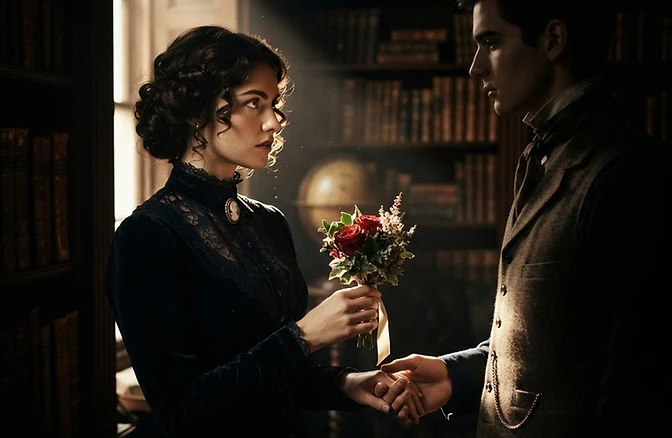
This was not just a random hobby; it was a structured system. There were actual dictionaries published that defined the meaning of every flower. A red rose, for example, was a clear declaration of love. However, a yellow carnation could signify rejection or disdain. The way a flower was presented—whether it was upside down or tied with a specific ribbon—could also change the entire meaning of the message.
By carefully selecting specific blooms, a person could send a detailed message to a recipient without saying a single word.
A Tool for Social Navigation
This floral code allowed people to navigate complex social situations. If a suitor sent a bouquet, the recipient would consult their dictionary to decode the intent. It was a way to test the waters or express sentiments that would have been scandalous if spoken in a crowded drawing room. It turned every garden visit into a potential conversation.
The Decline of the Code
As society became more open and the strict rules of the Victorian era faded, the need for such a secret language diminished. Today, we mostly choose flowers based on color or scent rather than their symbolic meaning. However, the legacy of floriography remains in our culture, with certain flowers still carrying strong associations, like lilies for funerals or red roses for Valentine's Day.
Why It Still Matters
Even if we don't use the full dictionary anymore, the idea of giving a gift with a 'hidden' meaning is still powerful. It shows that we value the effort of choosing something that represents our feelings. The language of flowers reminds us that communication is not just about the words we use, but the intention behind the gestures we make.
You're done
You just spent 3 minutes reading in English.
Enjoyed this story?
Tap the heart to let other readers know you enjoyed it.
My notes
Jot down personal reflections while you read — saved so you can review them later.
Check your understanding
4 questions with instant feedback
Let's talk about it
4 questions to spark conversation
Join the conversation
Your English doesn't have to be perfect — your ideas are what matter.
Respond to a question
Or share your reaction
No thoughts yet — be the first to start the discussion.
More from today


The Hayfever Hat: A Lesson in Bizarre Design
An exploration of 'Chindogu', the Japanese art of creating 'un-useless' inventions that solve problems in the most inconvenient ways possible.
The Inuit Goggles: A Survival Innovation
Long before modern sunglasses, the Inuit people developed ingenious bone goggles to protect their eyes from the harsh glare of the Arctic sun.
🕳️ Want to go deeper?
Keep exploring
What other secret languages existed in history?
How do different cultures interpret the meaning of flowers today?
Take It With You
A few useful things you picked up
From “The Language of Flowers: A Victorian Secret Code”.
Useful Expressions
floriography
C2 · noun
the language of flowers, where specific flowers have symbolic meanings
“Floriography was a popular way to communicate in the 19th century.”
The central term of the article.
bloom
B2 · noun
a flower, especially one cultivated for its beauty
“The garden was full of beautiful spring blooms.”
A natural synonym for flower.
scandalous
C1 · adjective
causing public outrage by a perceived offense against morality
“It would have been scandalous to speak those words in public.”
Useful for describing social norms.
suitor
C1 · noun
a man who pursues a relationship with a particular woman
“The suitor brought a bouquet of flowers to the house.”
Essential for the historical context of the story.
Your English
You don’t need to memorise these now. You’ll meet useful language again as you keep reading.
See you tomorrow.
View your collection