The Parasol: A Status Symbol That Defied the Sun
Long before they were tools for rainy days, umbrellas were elite accessories designed to shield the powerful from the sun's harsh rays.

Before you read
4 key words from this story
From Divine Shade to Daily Utility
For thousands of years, the umbrella—or more accurately, the parasol—was not a humble accessory for a rainy commute. In ancient civilizations across Egypt, Assyria, and China, these devices were reserved for the elite. They served as potent symbols of high status and divine authority, marking the difference between those who toiled under the sun and those who commanded the shade. The very etymology of the word, derived from the Latin 'umbra' meaning 'shadow', reveals its original purpose: to provide a portable sanctuary from the heat.
The Evolution of the Frame
While early versions were often heavy and cumbersome, crafted from wood and palm leaves, the design underwent a radical transformation in the 19th century. In 1852, Samuel Fox, an English steel manufacturer, revolutionized the industry by introducing lightweight, steel-ribbed frames. This innovation made the umbrella significantly more portable and durable, shifting it from a luxury item for the aristocracy to a practical tool for the growing middle class. It was no longer just a mark of rank; it was a functional necessity for the modern urbanite.
The very etymology of the word, derived from the Latin 'umbra' meaning 'shadow', reveals its original purpose: to provide a portable sanctuary from the heat.
Cultural Shifts in Sun Protection
Interestingly, the perception of the parasol has fluctuated wildly across cultures and eras. In Victorian England, it was a staple of feminine fashion, often used for posing at society events like the Henley Royal Regatta. Conversely, in many modern Asian cities, the parasol remains a common sight, used by both men and women to protect their skin from UV damage. This practice highlights a fascinating cultural divide: while Westerners often associate umbrellas exclusively with rain, other parts of the world maintain a sophisticated, practical relationship with sun protection.
The Modern Sharing Economy
In our hyper-connected age, the umbrella is undergoing yet another evolution: the sharing economy. In cities like Brooklyn, automated kiosks now allow commuters to rent umbrellas via smartphone apps, much like bike-sharing programs. This shift addresses the age-old problem of the 'forgotten umbrella' and reflects a broader trend toward temporary access over permanent ownership. It is a curious full-circle moment for an object that began as a shared symbol of power and has now become a shared utility of the city street.
You're done
You just spent 3 minutes reading in English.
Enjoyed this story?
Tap the heart to let other readers know you enjoyed it.
My notes
Jot down personal reflections while you read — saved so you can review them later.
Check your understanding
4 questions with instant feedback
Let's talk about it
4 questions to spark conversation
Join the conversation
Your English doesn't have to be perfect — your ideas are what matter.
Respond to a question
Or share your reaction
No thoughts yet — be the first to start the discussion.
More from today

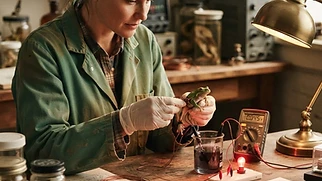
The Frog Battery: A Shocking Experiment
In the 18th century, a simple experiment with frog legs sparked a scientific revolution that led to our modern understanding of electricity.


The Jib Door: A Secret Passage in Your Living Room
Discover the history of the jib door, an architectural feature designed to disappear into the wall and hide private spaces from view.
🕳️ Want to go deeper?
Keep exploring
How did the invention of steel change other household objects?
What are the origins of other common superstitions?
Take It With You
A few useful things you picked up
From “The Parasol: A Status Symbol That Defied the Sun”.
Useful Expressions
Elite
C1 · noun
A select group that is superior in terms of ability or qualities to the rest of a group or society.
“The elite of the city gathered for the gala.”
Useful for describing social structures.
Sanctuary
C1 · noun
A place of refuge or safety.
“The library was his sanctuary from the noise of the street.”
A sophisticated word for a safe place.
Cumbersome
C1 · adjective
Large or heavy and therefore difficult to carry or use.
“The old equipment was too cumbersome to move easily.”
Excellent for describing physical objects.
Full-circle
C1 · idiom
A situation where something returns to its original state or position.
“The company has come full-circle, returning to its original mission.”
A natural way to describe cyclical change.
Your English
You don’t need to memorise these now. You’ll meet useful language again as you keep reading.
See you tomorrow.
View your collection