Urban Moss: The City's Quiet Cleaner
A tiny plant is doing a better job at fighting air pollution than many modern technologies.
Before you read
5 key words from this story
A Surprising Hero
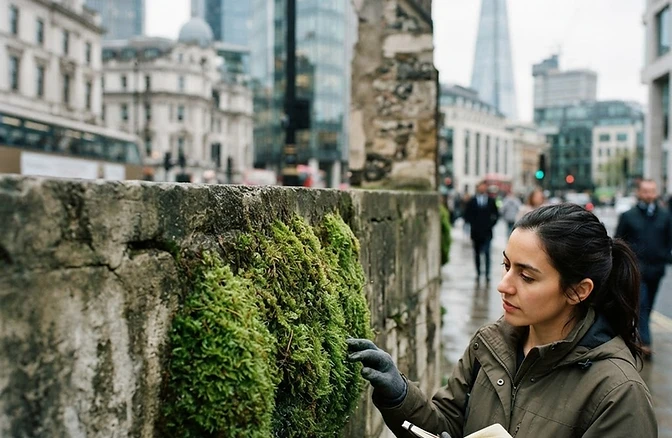
When we think of plants in a city, we usually think of trees or park flowers. But there is a much smaller, quieter worker living on our walls and sidewalks: moss. Scientists have discovered that this simple, ancient plant is an incredible "air filter." It is helping cities breathe easier in ways that metal and plastic machines cannot.
Nature's Air Filter
Moss does not have real roots; it gets its nutrients and water directly from the air. Because of this, it is excellent at trapping tiny dust particles and pollutants. A single "moss wall"—a vertical surface covered in the plant—can absorb as much carbon dioxide and fine dust as hundreds of trees. This makes it a secret weapon against urban air pollution.
" It is helping cities breathe easier in ways that metal and plastic machines cannot.
The City Challenge
Cities are difficult places for plants. They are often hot, dry, and lack the deep soil needed for big trees. Moss, however, is a survivor. It does not need much space or deep soil to grow. It can grow on concrete, brick, and stone. Because it can survive in these harsh environments, it can be installed in places where it is impossible to plant a tree.
Combining Tech and Nature
Engineers are now creating "City Trees"—units that combine beautiful moss structures with smart technology. These units have sensors that measure the air quality and fans that push air through the moss. It is a perfect marriage between ancient biology and modern engineering. It shows that sometimes, the best solution to a modern problem is to go back to basics.
Greener Future
As cities continue to grow, we need to think creatively about how to include nature. We cannot just wait for massive forests to solve our pollution issues. By using moss, we can turn grey, concrete walls into living, breathing filters. It is a low-cost, high-impact way to make our busy cities feel—and be—a little more natural.
You're done
You just spent 3 minutes reading in English.
Enjoyed this story?
Tap the heart to let other readers know you enjoyed it.
My notes
Jot down personal reflections while you read — saved so you can review them later.
Check your understanding
4 questions with instant feedback
Let's talk about it
4 questions to spark conversation
Join the conversation
Your English doesn't have to be perfect — your ideas are what matter.
Respond to a question
Or share your reaction
No thoughts yet — be the first to start the discussion.
More from today


The Library of Babel: A Digital Infinite
An online project recreates a fictional library containing every possible combination of letters, effectively holding all knowledge and nonsense.

Cheese: A Happy Accident in a Bag
Long ago, a traveler discovered that milk stored in an animal stomach turned into something delicious and solid.
🕳️ Want to go deeper?
Keep exploring
What other plants are good at cleaning the air inside our homes?
Can moss be used to reduce noise pollution in cities as well?
Take It With You
A few useful things you picked up
From “Urban Moss: The City's Quiet Cleaner”.
Useful Expressions
Pollutant
B2 · noun
A substance that makes air, water, or soil dirty or unsafe.
“Smoke from cars is a major pollutant.”
Essential for environmental discussions.
Trapping
B1 · verb
To catch or keep something in a place.
“The filter is trapping the dust.”
Commonly used to describe physical processes.
Vertical
B2 · adjective
Standing straight up, not flat on the ground.
“They built a vertical garden on the side of the building.”
Useful for describing architecture and design.
Harsh
B2 · adjective
Difficult, unpleasant, or severe.
“The plant survived in the harsh desert heat.”
Useful for describing environments.
Your English
You don’t need to memorise these now. You’ll meet useful language again as you keep reading.
See you tomorrow.
View your collection