The Fortune Cookie: An American Invention
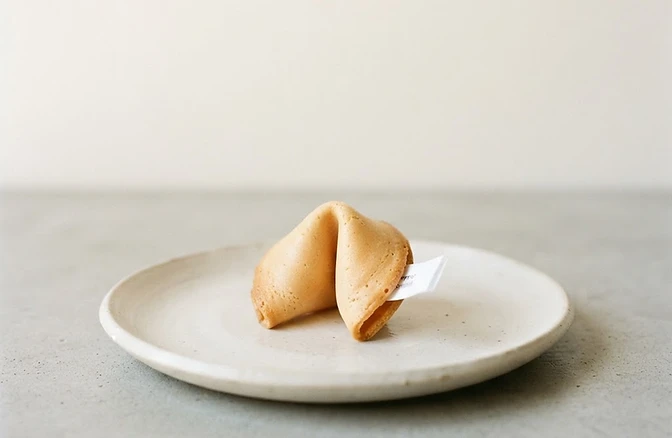
Despite being a staple of Chinese restaurants in the West, the fortune cookie is a distinctly American creation with roots in Japanese tradition.
Before you read
3 key words from this story
Highlight a sentence, leave a note
Select any sentence in the story to share what you think. Your notes appear right on the text, so your classmates can read them, react, and reply — exactly where it matters.
What it looks like
The river carved its path through the valley as the town looked on.
3 notes · click any highlight to read them
A Misunderstood Treat
If you visit a Chinese restaurant in the United States, you will almost certainly receive a fortune cookie at the end of your meal. It is a crisp, sweet wafer containing a small slip of paper with a prediction or a proverb. Most people assume this is a traditional Chinese dessert, but you would be surprised to learn that it is almost unknown in China.
The Japanese Connection
Historical research suggests that the fortune cookie actually has its roots in Japan. In the late 19th century, a similar cookie called 'tsujiura senbei' was sold at shrines in Kyoto. These cookies were larger, darker, and flavored with miso and sesame rather than the vanilla and butter used in the American version. They also contained a fortune, but it was tucked into the fold of the cookie rather than hidden inside.
The Japanese Connection Historical research suggests that the fortune cookie actually has its roots in Japan.
The California Migration
How did a Japanese snack become a Chinese restaurant staple? The answer lies in early 20th-century California. Japanese immigrants in San Francisco and Los Angeles began producing these cookies for their own bakeries. However, during World War II, when Japanese-Americans were forced into internment camps, many of their businesses were closed. Chinese entrepreneurs saw an opportunity and began producing the cookies themselves, eventually making them a standard feature of the Chinese-American dining experience.
A Cultural Hybrid
This evolution is a perfect example of how food travels and changes. The fortune cookie is not 'authentic' in the traditional sense, but it is a genuine part of the American culinary landscape. It represents the way different cultures interact, adapt, and create something entirely new. It is a snack that was invented by one group, popularized by another, and consumed by everyone.
The Power of the Prediction
Beyond the history, there is the psychology of the fortune. Why do we enjoy them so much? Even if we know the predictions are random, there is a small, playful thrill in opening the cookie. It is a moment of lighthearted mystery that adds a sense of fun to the end of a meal. Whether the fortune is wise or silly, it serves as a shared social experience that connects diners across the table.
You're done
You just spent 3 minutes reading in English.
Enjoyed this story?
Tap the heart to let other readers know you enjoyed it.
My notes
Jot down personal reflections while you read — saved so you can review them later.
Check your understanding
4 questions with instant feedback
Let's talk about it
4 questions to spark conversation
Join the conversation
Your English doesn't have to be perfect — your ideas are what matter.
Respond to a question
Or share your reaction
No thoughts yet — be the first to start the discussion.
More from today


Negativity Bias: Why Our Brains Prioritize the Bad
Humans are evolutionarily hardwired to fixate on negative experiences, a survival mechanism that often backfires in our modern, safer world.


The Air Conditioner: A Machine That Changed Geography
Before the invention of modern cooling, entire regions of the world were considered too hot for major industrial or political centers.
🕳️ Want to go deeper?
Keep exploring
What other foods have surprising origins?
How do food trends spread across the world?
Take It With You
A few useful things you picked up
From “The Fortune Cookie: An American Invention”.
Useful Expressions
staple
B2 · noun
a main or important element of something
“Rice is a staple food in many countries.”
Commonly used to describe essential items.
culinary
C1 · adjective
related to cooking or the kitchen
“She is exploring the culinary traditions of Italy.”
Useful for discussing food and culture.
hybrid
B2 · noun
something made by combining two different things
“The car is a hybrid of electric and gas power.”
Good for describing modern, mixed concepts.
Your English
You don’t need to memorise these now. You’ll meet useful language again as you keep reading.
See you tomorrow.
View your collection