The Secret Language of Bees: How They Talk
Bees use a complex dance to tell their friends exactly where to find the best flowers.
Before you read
3 key words from this story
A Tiny Dance
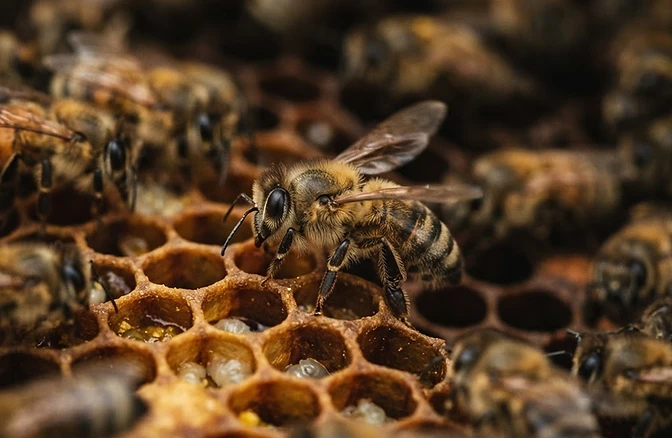
If you watch a beehive, you might see bees moving in a strange, wiggling pattern. This is not just random movement; it is a language. Scientists call it the 'waggle dance.' When a bee finds a good source of nectar, it returns to the hive and performs this dance to tell the other bees where to go.
The Map in the Hive
The dance is incredibly precise. The angle of the dance tells the other bees the direction of the flowers relative to the sun. The length of the dance tells them how far away the flowers are. It is essentially a map that the bees can read in the dark, inside the hive.
A Tiny Dance If you watch a beehive, you might see bees moving in a strange, wiggling pattern.
Why It Matters
This communication is vital for the survival of the colony. Bees need to collect nectar from thousands of flowers to make honey and feed their young. By sharing information, they save energy and ensure that the whole group can find food efficiently. It is a perfect example of teamwork in nature.
More Than Just Food
Bees also use other signals, like vibrations and scents, to communicate. They can warn each other of danger or tell the hive that it is time to move to a new home. Their world is much noisier and more active than it looks to our human eyes.
Learning from Bees
Humans have spent centuries trying to understand how bees communicate. By studying them, we have learned a lot about how groups can work together to solve problems. Bees show us that even the smallest creatures can have complex social lives and amazing ways of sharing information.
You're done
You just spent 3 minutes reading in English.
Enjoyed this story?
Tap the heart to let other readers know you enjoyed it.
My notes
Jot down personal reflections while you read — saved so you can review them later.
Check your understanding
4 questions with instant feedback
Let's talk about it
4 questions to spark conversation
Join the conversation
Your English doesn't have to be perfect — your ideas are what matter.
Respond to a question
Or share your reaction
No thoughts yet — be the first to start the discussion.
More from today


The Rubber Eraser: A Mistake That Changed Writing
Before the rubber eraser, people used bread to fix their writing mistakes.

Your Kitchen Sponge Is Dirtier Than Your Toilet
Scientific studies show that the humble kitchen sponge is one of the most bacteria-filled items in a typical home.
🕳️ Want to go deeper?
Keep exploring
How do other insects communicate?
What would happen to our food supply if bees disappeared?
Take It With You
A few useful things you picked up
From “The Secret Language of Bees: How They Talk”.
Useful Expressions
nectar
B2 · noun
a sweet liquid produced by flowers
“Bees collect nectar to make honey.”
Essential for talking about nature and biology.
efficiently
B2 · adverb
doing something well without wasting time or energy
“She works very efficiently and finishes early.”
A very useful word for work and daily life.
colony
B2 · noun
a group of animals of the same type living together
“The ant colony was very busy.”
Commonly used in science and history.
Your English
You don’t need to memorise these now. You’ll meet useful language again as you keep reading.
See you tomorrow.
View your collection